
Something has shifted in how overseas Pakistanis look at property back home. It’s no longer just about location and price; a faith-based structure has become a real deciding factor. In 2026, Shariah-compliant investment real estate is pulling in serious attention from the diaspora, and there are practical reasons behind that shift, not just emotional ones. Developers like PrimeLand Properties have built their entire model around this demand.
Why Shariah-Compliant Real Estate Is Gaining Popularity in 2026
Trust has always been the biggest hurdle for overseas buyers. Fraud, unclear contracts, and interest-loaded financing kept many diaspora investors on the sidelines for years. That’s changing now. The State Bank of Pakistan’s Roshan Apna Ghar scheme, launched for non-resident Pakistanis, offers financing in both conventional and Shariah-compliant variants, and it’s been a genuine game-changer for buyers who wanted a halal route into property ownership. Add to that a new tax-free property package rolled out in 2026 for NRPs, and the timing for faith-based real estate investment has never looked better.
What Makes a Real Estate Project Shariah-Compliant?
A truly Shariah-compliant investment project avoids riba, or interest, at every stage from the developer’s own financing to the buyer’s payment plan. There’s no penalty interest on late installments, no hidden markup disguised as a “service charge.” Contracts stay transparent, ownership transfer is clear, and speculative or ambiguous terms (gharar) are avoided. Some developers also bring in a Shariah advisory board to review contracts before launch. It’s worth asking directly whether a project has that kind of religious oversight, because plenty of projects use the word “Shariah-compliant” loosely without any real certification behind it.
Why Overseas Pakistanis Prefer Shariah-Compliant Investments
For many in the diaspora, this isn’t just a financial checkbox. Investing in something built on riba while living abroad, away from daily religious community, feels different than doing it locally somehow. There’s also a practical layer here. Diaspora investors want certainty, and Shariah-compliant structures usually come with clearer refund policies and fixed payment terms, since ambiguity itself is something Islamic finance tries to eliminate.
Key Benefits of Shariah-Compliant Investment Property
Shariah-compliant property investment offers several clear benefits. There are no interest charges, which makes the total cost easier to understand and plan. The agreed price and payment terms are clearly set from the start. Contracts are also designed to be simple and transparent, without confusing interest or hidden charges. For buyers who want their investments to follow Islamic principles, this approach also provides peace of mind.
Shariah-Compliant Projects vs. Conventional Real Estate
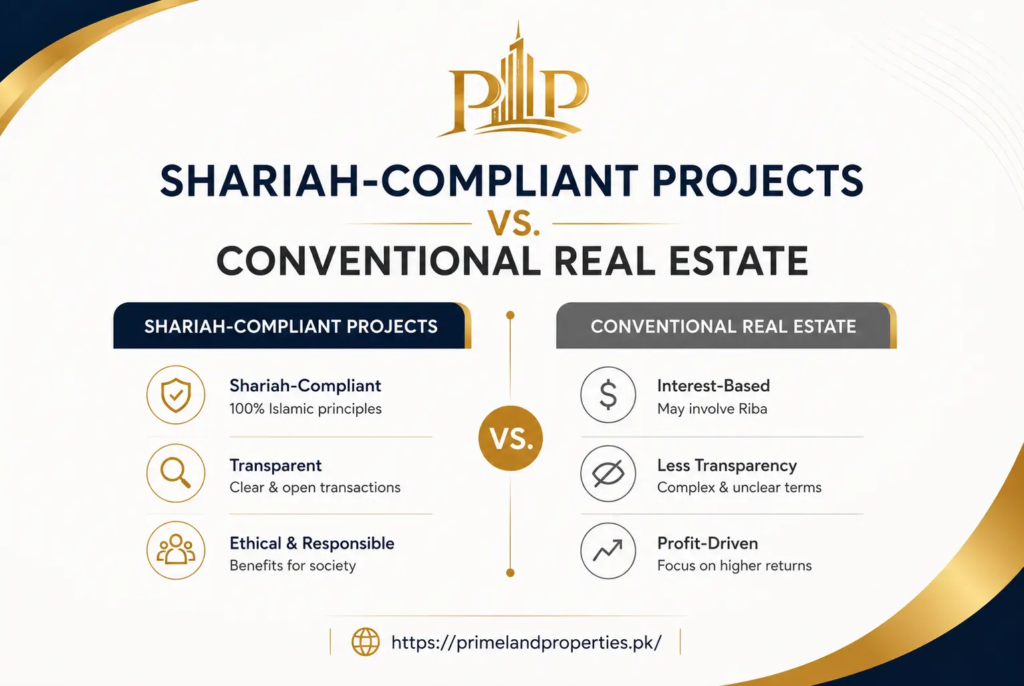
Conventional developers often attach interest to late payments, or restructure deals in ways that quietly shift risk onto the buyer. Shariah-compliant investment developers can’t do that; the whole model rules it out. Conventional projects can still be legitimate and well-built, to be fair. The difference sits mainly in the financial structure, not necessarily construction quality. Still, for a buyer sending money from abroad without the ability to check on progress every week, a fixed, interest-free structure removes one entire category of financial risk.
How Shariah Compliance Builds Investor Confidence
Confidence comes from predictability, and predictability comes from clear rules. When a buyer knows upfront that installments won’t balloon due to penalty interest, and that a refund policy actually protects their deposit, half the anxiety of investing remotely just disappears. Pakistan’s regulatory environment has also caught up: the SECP now regulates several Shariah-compliant REITs, and Islamic finance standards continue to be formalized year over year. That institutional backing gives overseas buyers something to point to beyond a developer’s own marketing claims.
Popular Shariah-Compliant Real Estate Projects in Pakistan
ABS Developers positions itself as Pakistan’s first 100% Shariah-compliant real estate company, with projects like Pearl One Courtyard in Bahria Town Lahore and Sialkot Central built entirely on riba-free terms. Both combine residential and commercial spaces, providing investors with multiple income streams within a single Shariah-compliant structure. Buyers exploring options closer to Lahore’s Bahria Orchard area can also look at Pearl One Royal, which follows the same compliance model on a different site.
What Overseas Pakistanis Should Check Before Investing
Don’t take “Shariah-compliant” at face value; ask for the actual documentation. Check whether a Shariah advisory board reviewed the contract, confirm the refund policy in writing, and get the full payment schedule before sending any money. It also helps to verify the developer’s registration and delivery history; a portfolio of completed projects tells you more than any brochure. For financing questions, the State Bank of Pakistan’s Roshan Apna Ghar program is a solid starting point to understand what’s officially available to NRPs.
How to Choose the Right Shariah-Compliant Project
Start with the developer’s track record, not the project’s marketing pitch. Look at how many projects they’ve actually delivered versus how many are still “under construction” years later. Compare payment plans across two or three developers. Shariah-compliant doesn’t mean identical terms everywhere, and details like installment length or down payment size still vary quite a bit. Location matters just as much here as in any conventional investment, so don’t let the Shariah-compliant investment label override basic due diligence on where the project actually sits.
Final Thoughts
The appeal of Shariah-compliant investment real estate is not a passing fancy for overseas Pakistanis; it’s actually linked to a real gap that is being filled for the first time by developers and state-backed initiatives like the Roshan Apna Ghar. However, “Shariah-compliant” is a designation that should be verified and not assumed. Don’t be afraid to raise questions and study the contract carefully to be satisfied with it in writing before sending your money from abroad. Done right, this route offers overseas buyers something conventional real estate often struggles to provide: predictability, transparency, and a transaction that sits comfortably with their values. To explore verified options, visit PrimeLand Properties directly.